Building a game is one of the most exciting and rewarding experiences for any game developer. Whether you want to build a Mobile Game, PC Game, Console or VR Game, the process remains the same.
To build a game, you need to have an idea first.
NOTE: This article is for beginners, independent of the game engine you will use to build the game. The process is the same for every game. It does not provide code or any technical details.
An idea
An idea is the most important prerequisite for building a game. And fortunately there is no shortage of ideas.
Few ideas for a game can be:
- Dodge the falling objects
- Endless runner game (like Subway Surfers, Temple Run)
- puzzle game (like Candy Crush, 2048)
- Survival game (like Rust, Minecraft)
In this article, we will focus on building Dodge the falling objects game. This game idea is small enough to be built as a first game, but also large enough to teach the fundamentals of building your first game as well as the game development.
Now we have an Idea, let's move to the next step.
Defining the Game from the Idea
To me, ideas are worth nothing unless executed. They are just a multiplier. Execution is worth millions. -- Steve Jobs
To define the game, we need to answer the following questions, but these are not the only ones:
- Is it a 2D or 3D game?
- How can player interact with the game?
- What is the objective of the game?
- What are the rules of the game?
- What is the reward for the player for playing the game?
Here are the answers to the above questions for our game idea:
- It is a 2D game.
- The player can interact with the game by moving left and right to dodge the falling objects.
- The objective of the game is to survive as long as possible by dodging the falling objects.
- The rules of the game are:
- The player can only move left and right.
- The player loses if they get hit by a falling object.
- The game gets progressively harder as time goes on, with more objects falling faster.
- The reward for the player is a high score, which can be shared with friends and family.
Now we have defined, we need a way to create an MPV.
Minimum Playable Version (MPV)
A minimum playable version (MPV) is a version of the game that has the core mechanics and features implemented, but may not have all the polish and content of the final game. The goal of an MPV is to test the core gameplay and mechanics, and to get feedback from players.
Now we have defined the game, and we need to create MPV from it. To create the MPV, we need to design the game.
Here is the rough design of the game I have created:
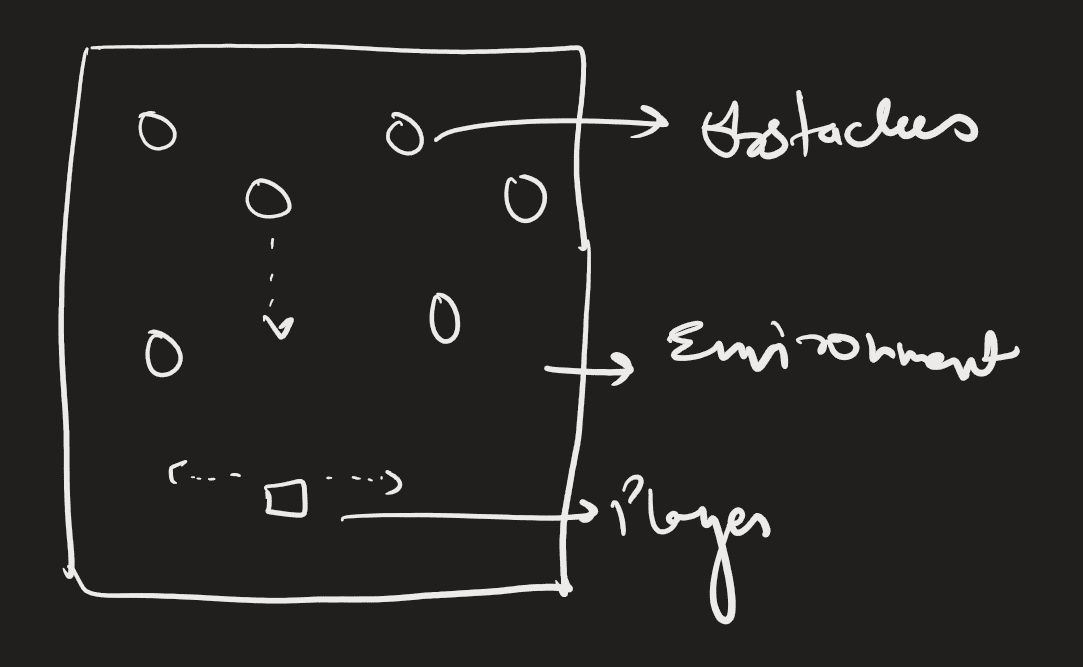
Game Development
Defining, designing, and creating an MPV is the first step, but without actually building it, it is still just an idea.
1. Build the First Playable Version
At this stage, you only need to build the minimum core mechanics required to make the game playable.
For our game, we need to implement the following core mechanics:
- Use only primitive shapes for each object (player, enemy, and background).
- Don't add anything that is not required to play the game at this stage
move -> avoid falling objects -> survive -> eventually lose -> restart
2. Play the Game
After building the MPV, you need to play the game to see if it is actually playable or you have made it playable in your head only.
3. Iterate
Fix the problems you found while playing the game.
Game development is a repeating process of building, playing and testing.
Idea -> Build -> Play -> learn -> Change -> Build Again
4. Add Polish
After the core gameplay works, you can add polish to the game.
For example:
- background music
- sound effects
- visual effects
- feedback
- progression
NOTE: Don't add polish before the core gameplay works. It is a waste of time and resources.
5. Test the Game with someone else
You should let someone else play the game, because you understand the game too well and a new player doesn't, from a different perspective you will get actual feedback on how to improve the game.
Just hand over the game to them, let them figure out and play the game, and observe.
6. Ship the Game
Once you have tested, refined the game. you should not wait long enough to make everything perfect. Instead you need to ship the game, to test the waters and get feedback for the actual gamers.
Learn from the experience
Congratulations! You have built your first game. Now you need to learn from the experience and improve your skills for the next game.